Longfin grouper

Home/Marine Life/Longfin grouper
- Name / Latin
- Longfin grouper — Epinephelus quoyanus
- Brief description
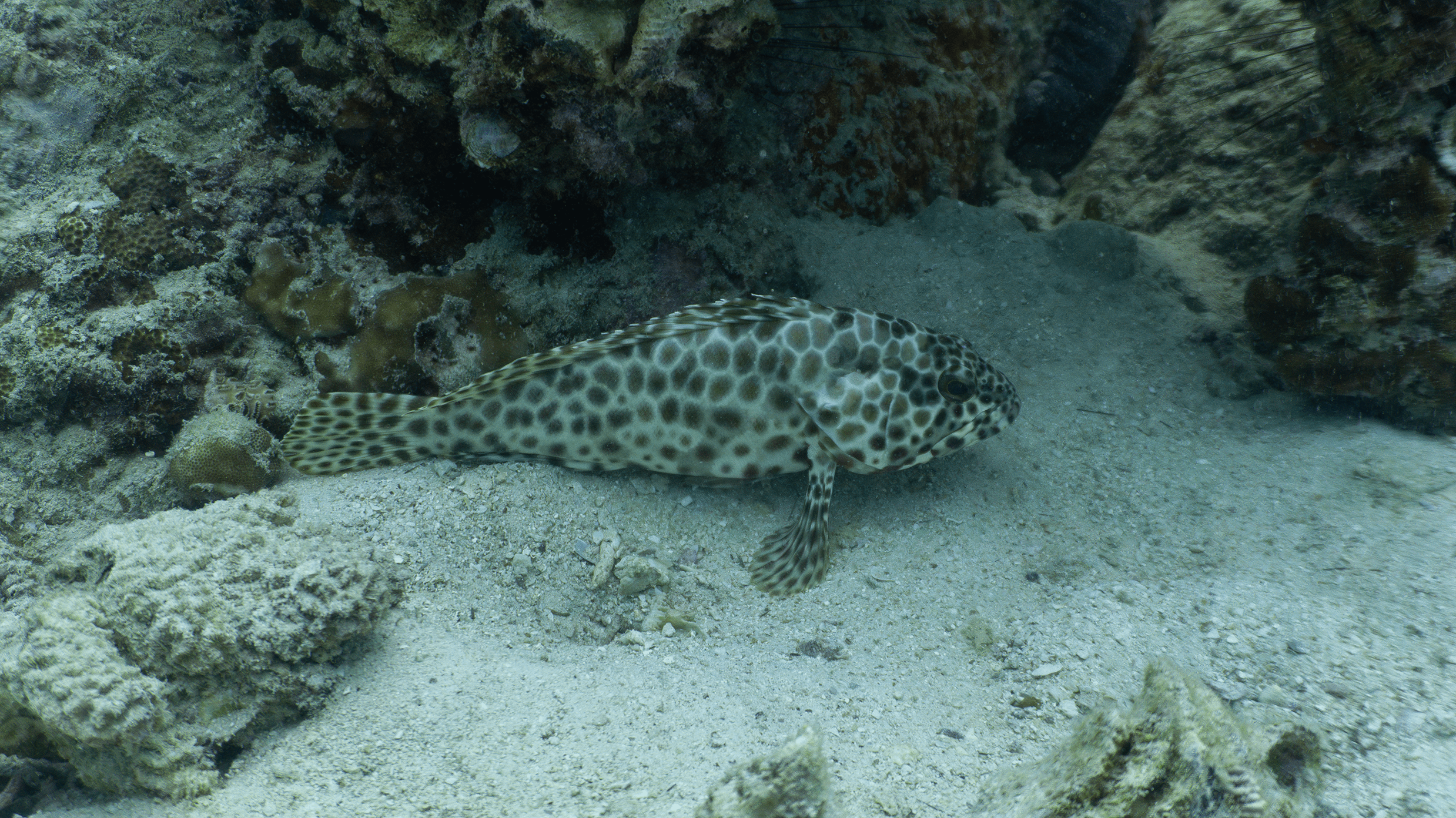
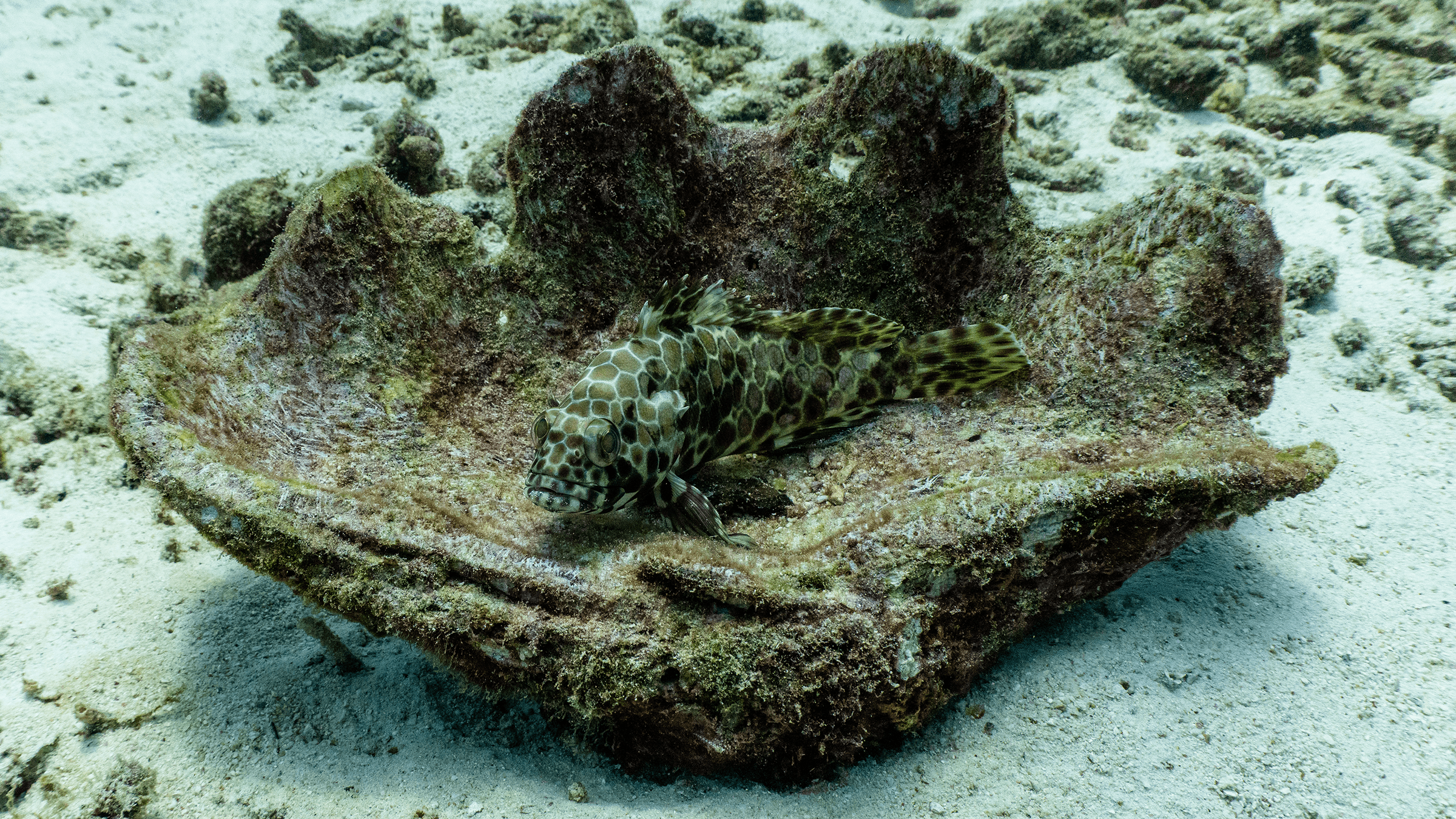
- The longfin grouper is a small reef predator with a light "honey" colour and a dense pattern of dark hexagonal or rounded spots on the head, body and fins. On the upper body the pattern looks more like a network; lower down the spots are fewer and less distinct. It is usually sluggish and often "sits" on the bottom resting on its long, fleshy pectoral fins; it feeds on small fish, crustaceans and worms.
- Size:
- up to 40 cm
- Depth:
- down to 50 m
- Habitat:
- Indo-Pacific region
- Family:
- Serranidae
- Type:
- Fish
- Activity:
- Sedentary, ambush predator
- Conservation status:
- Least Concern (LC) — not threatened with extinction according to IUCN assessment
The longfin grouper has an elongated body, 2.8–3.2 times longer than it is deep. The head is smoothly curved, with an almost straight upper edge to the gill cover. The dorsal fin has 11 sharp spines and 16–18 soft rays; the anal fin has 3 spines and 8 soft rays. The tail fin is rounded, and the pectoral fins are almost twice as long as the head, which sets this species apart from other groupers. Coloration is light with many dark spots forming a dense pattern on the top of the head and body, while lower down the spots are fewer and more blurred. The dorsal, anal and tail fins also have similar spots.
On the chest there are two dark bands that meet under the pectoral fin, forming a light patch. Another light patch lies between these bands and a dark spot at the base of the pectoral fin. Dark spots and bands are also visible on the throat and chest, and on the head the spots become smaller towards the snout. At the base of the upper jaw on the cheek there is a light square-shaped patch.
The longfin grouper lives in the Indo-Pacific, including the Indo-Malay archipelago, the Andaman Islands and the north coast of Australia. It prefers muddy reefs and sandy bottom at depths down to 50 metres.
It feeds on worms, small fish and crustaceans. It is an active predator and often hunts from ambush.
The longfin grouper is not dangerous to humans. However, if threatened it can become territorial and defend its area.
The longfin grouper is a hermaphrodite. All fish start as females and reach maturity at about 24 cm. Later, at about 33 cm, they change sex and become males.
This species was first described in 1830 by the French zoologist Achille Valenciennes and was named after the naturalist Jean René Constant Quoy.