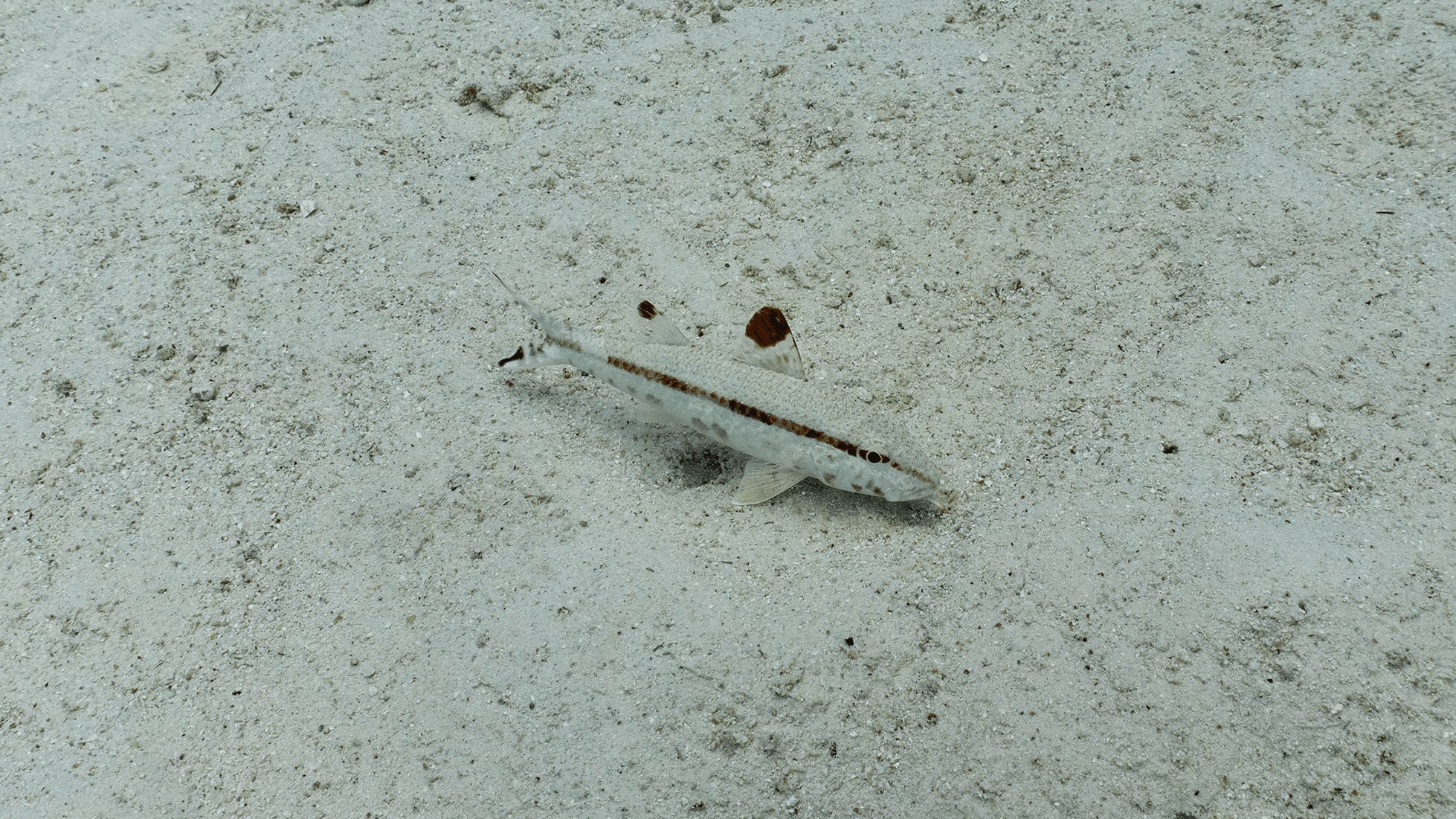
Freckled Goatfish
Home/Marine Life/Freckled Goatfish
- Name / Latin
- Freckled Goatfish — Upeneus tragula
- Brief description
- A bottom-dwelling fish with an elongated body and two sensitive barbels on the chin, used to search for food in the sand. Light coloration with a longitudinal dark stripe and rows of spots on the sides.
- Size:
- up to 20 cm
- Depth:
- 1–60 m
- Habitat:
- Red Sea, Indian Ocean, Western Pacific Ocean
- Family:
- Mullidae
- Type:
- Fish
- Activity:
- diurnal
- Conservation status:
- Least Concern (LC) — not threatened with extinction according to IUCN assessment
The freckled goatfish (Upeneus tragula), also known as the spotted goatfish, is a bottom-dwelling fish that typically reaches up to 20 cm in length. It has a characteristic elongated body with a slightly compressed shape. The fish's coloration usually varies from pale pink to reddish with a series of dark brown or black spots scattered along the sides. These spots give it a freckled appearance, which is a key identifying feature. The fish also has two long barbels on the chin, which it uses to detect food on the ocean floor.
The freckled goatfish usually inhabits tropical and subtropical areas of the Indo-Pacific region. It inhabits sandy and muddy bottoms, often near coral reefs or seagrass beds. These fish are usually found at depths from 1 to 60 meters, where they can easily forage for food.
The freckled goatfish reproduces through spawning, when females release eggs into the water column, and males fertilize them externally. The eggs are pelagic, meaning they float in open water until hatching. The larvae then develop and settle to the bottom as they mature.
The freckled goatfish feeds mainly on small invertebrates such as crustaceans, worms, and mollusks. It uses its sensitive barbels to detect prey hidden in the sand or mud.
The freckled goatfish poses no danger to divers. It is usually shy and swims away when approached.